+86-18018686956
 [email protected]
 Language
 русский
 Español
 عربى
عربى Tiếng Việt

Inquiry
+86-18018686956
[email protected]
Language
Open almost any package in a supermarket aisle and you will find adhesive doing quiet, invisible work. It seals carton flaps, bonds pouch laminates, and fixes labels to jars, films, and paperboard sleeves. Because it never appears on an ingredient statement, regulators treat it differently from everything else that surrounds food: not as an ingredient, but as a potential indirect food additive.
In the United States, the anchor rule for that treatment is 21 CFR 175.105, the federal regulation covering adhesives used in packaging, transporting, and holding food. This guide explains what the rule actually requires, where its boundaries sit, how compliance is demonstrated in practice, and what it means for anyone who buys or converts label materials for food products. The goal is practical: fewer assumptions, sharper questions, and cleaner documentation.
Title 21 of the Code of Federal Regulations gathers the food additive rules administered by the FDA, and Part 175 within it covers indirect food additives: adhesives and components of coatings. Section 175.105 is the core clearance for adhesives used as components of articles intended for packaging, transporting, or holding food. The first half of the rule is a substances list: base polymers and resins, plasticizers, waxes, solvents, and other ingredients are named, and each entry carries any limitations attached to it. An adhesive built from listed substances, respected within those limits, has cleared the formulation hurdle. Cross references inside the list point to other parts of the food additive regulations, so the screening exercise is genuinely technical rather than a formality.
The second half of the rule controls exposure, and the opening paragraph sets the tone in plain language:
The quantity of adhesive that contacts packaged fatty and aqueous foods shall not exceed the trace amount at seams and at the edge exposure between the laminates that may occur during normal use.
Adhesives may therefore sit near wet or fatty foods only as thin residual lines at glued seams and laminate edges, never as a visible surface layer. Dry foods are the exception: an adhesive formulated from cleared substances may contact dry food directly, which is why cartons and bags for flour, cereals, sugar, and baking mixes rely on this section so heavily. The regulation also carries an expectation of suitable purity, meaning that even a listed ingredient must be produced at a quality appropriate for food packaging, under reasonable process control.
Sorted by contact scenario, the practical scope looks like this:
| Contact scenario | Regulatory expectation | Typical packaging examples |
|---|---|---|
| Dry food, direct contact | Adhesive may touch the food; ingredients must all come from the cleared substances list | Cartons and bags for flour, sugar, cereals, and dry mixes |
| Fatty or aqueous food | Contact limited to trace amounts at seams and laminate edges | Laminated pouches and sealed cartons for sauces and dairy |
| Functional barrier construction | Adhesive fully separated from food by a proven layer | Multilayer film laminates for liquid and high-fat products |
| Adhesive as food-contact surface | Outside 175.105; governed by the separate pressure-sensitive adhesive rule | Produce stickers and tapes applied directly to food |
One boundary matters especially to label buyers. Section 175.105 was written for adhesives as indirect components. Pressure-sensitive adhesives that are intentionally applied as the food-contact surface, such as identity stickers on fruit or tape used on raw meat and poultry, fall under Section 175.125, which carries stricter conditions, including a reasonably impermeable backing and a minimal adhesive quantity. For everything else, the laminated pouch bond line, the carton seam, and the adhesive on a label applied to the outside of a package, 175.105 remains the reference point.
No authority pre-approves a finished adhesive product. Compliance is built and documented by the supply chain itself, and it rests on four pillars: classification, formulation screening, migration evidence, and documentation discipline. The sequence below reflects how experienced converters and material suppliers actually run the process.
Classification comes first. The team describes the food using the standard nine-type system used throughout FDA indirect food additive rules, which runs from nonacid aqueous products through acidic beverages, dairy and its modifications, low-moisture fats and oils, bakery products, and dry solids with or without free fat or oil on the surface. They then fix the harshest end-use condition the package will face, from high-temperature sterilization at about 121 degrees Celsius, through hot-fill and pasteurization, room-temperature storage, refrigeration, and frozen distribution. These two choices drive every later decision, so they deserve to be written down rather than remembered.
Formulation screening follows. Every ingredient is checked against the substances list in Section 175.105, including any limitations attached to individual entries, and against the other recognized clearance paths: prior sanctions, determinations that a substance is generally recognized as safe, effective food contact notifications, and the threshold-of-regulation route for substances whose dietary exposure stays extremely low. An ingredient that appears on none of these paths has to be replaced. Purity is part of the same review, because a listed substance made with unsuitable impurities is not automatically acceptable.
Migration evidence closes the technical loop. Laboratories expose the finished construction to food-simulating liquids at time and temperature settings matched to the intended use, then quantify whatever migrates. Fatty simulants serve fatty foods; aqueous and acidic liquids serve their counterparts. The resulting report becomes the objective record showing that the trace-amount expectation, or the claimed functional barrier, actually holds in storage.
Documentation then keeps the work alive across the product life cycle. Suppliers issue letters of guarantee and, under confidentiality, full formulation declarations; laboratories issue test reports; buyers retain certificates of analysis and monitor formulation changes. Whenever a raw material, a process temperature, or a package design changes, the assessment is refreshed before the change ships. This is unglamorous work, but it is precisely what an inspector, an auditor, or a customer quality team will ask to see first.
A pressure-sensitive label is a small laminate in its own right: a face stock, a pressure-sensitive adhesive, and a silicone release liner that carries the construction until the moment of application. When the label goes onto food packaging, the adhesive layer is the compliance-critical component, yet the face stock shapes the outcome as well. Absorbent papers can wick adhesive at the die-cut edge, while dense films hold the adhesive where it belongs. Matching face stock, adhesive, and end use is therefore a compliance decision, not only an aesthetic one.
For dry and low-moisture foods, paper constructions are the workhorses. A kraft paper label supports a natural, artisan positioning on bakery and pantry packaging, and its adhesive system can be specified for direct dry-food contact under 175.105 with a fully cleared formulation.
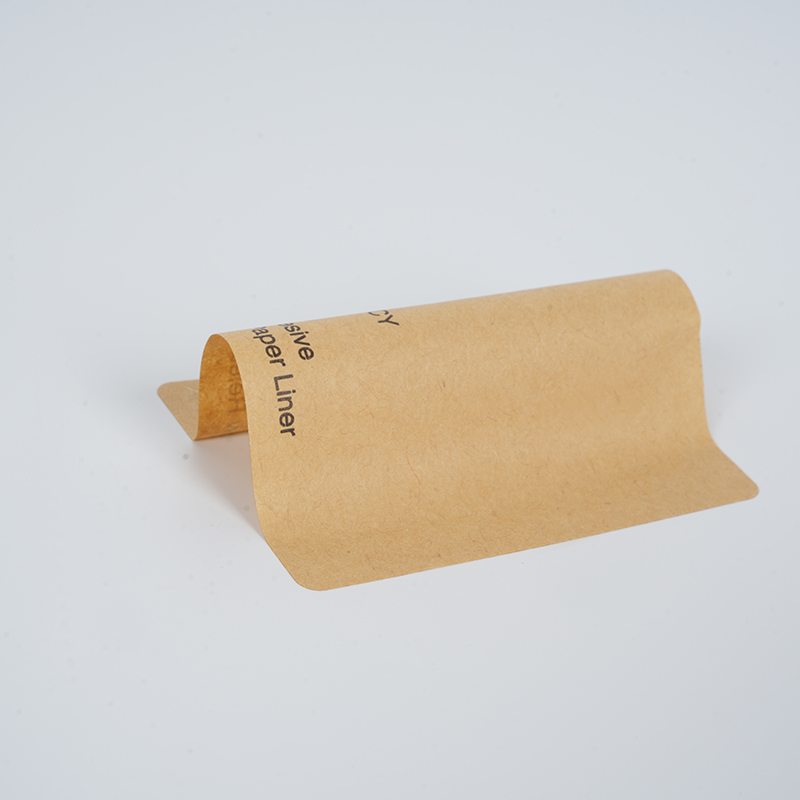 Kraft Paper Labels for Dry Food PackagingMade from long, tightly interwoven fibers, kraft paper offers durability and a natural look. It suits bakery and pantry packaging and can be specified with adhesives for direct dry-food contact.View Product →
Where shelves are crowded and print quality carries the sale, semigloss paper provides a bright, smooth surface for ingredient panels and brand graphics on cartons, jars, and film surfaces, again paired with an adhesive appropriate to the substrate and the food inside.
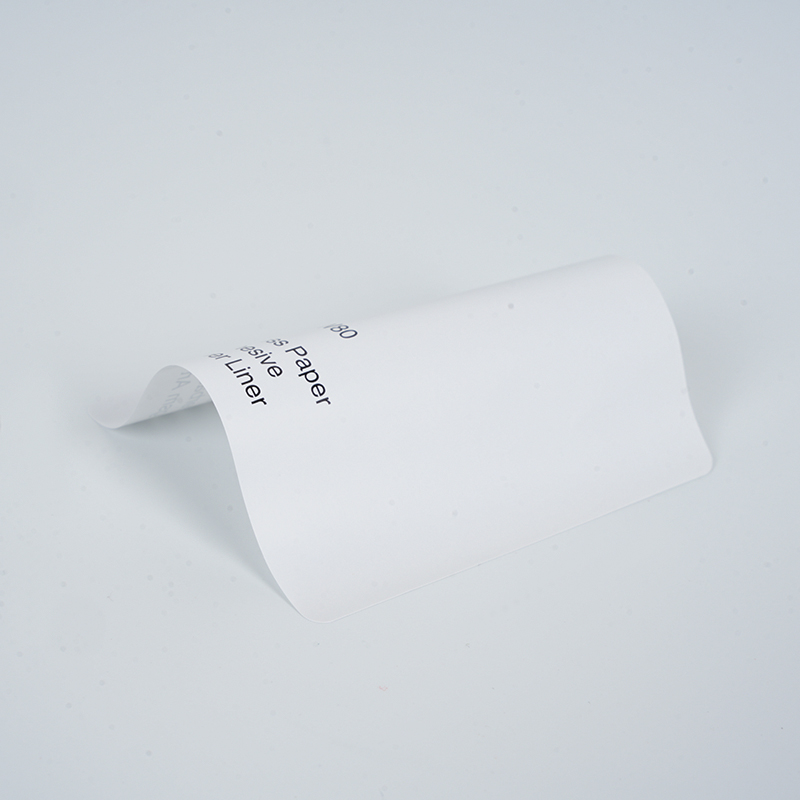 Semi-Gloss Paper for High-Quality Print LabelsCoated for a smooth, bright surface, semi-gloss paper delivers strong ink acceptance and color. It works well for ingredient panels and brand graphics on cartons, jars, and film surfaces.View Product →
Refrigerated, frozen, and high-moisture environments push selection toward films and synthetic paper, which resist moisture uptake, keep printed information legible through condensation cycles, and preserve adhesive anchorage in cold rooms and chill cabinets. Frozen distribution also stresses adhesives, since reduced tack and cold flow appear exactly where labels are handled least.
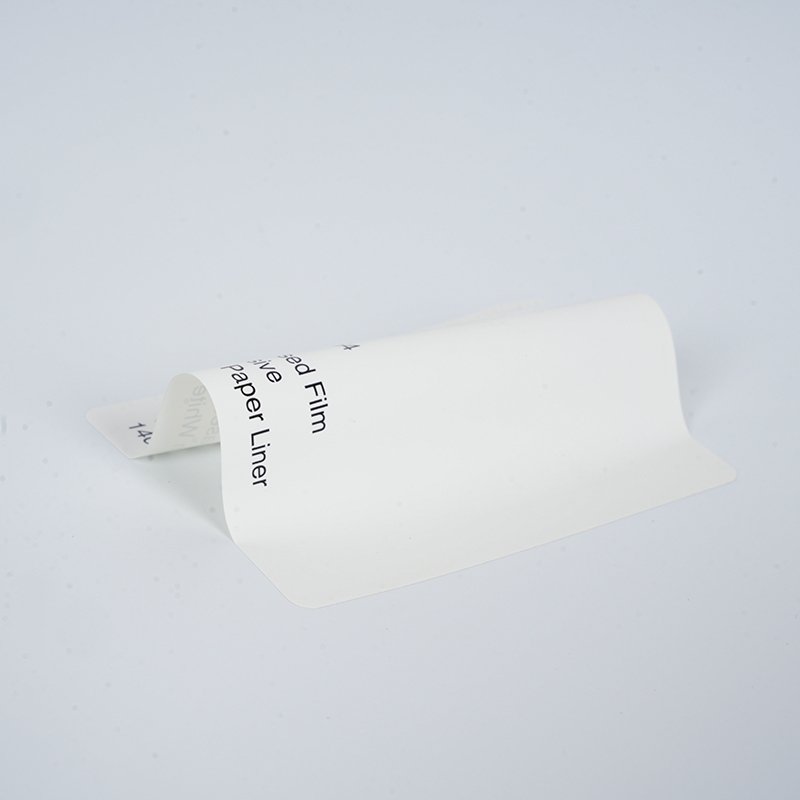 Custom Synthetic Paper Label MaterialsSynthetic paper resists moisture uptake and keeps printing legible through condensation, making it a strong choice for refrigerated, frozen, and high-moisture labeling environments.View Product →
Because the construction behaves as a system, selection is easiest when face stock and adhesive are evaluated together rather than ordered separately. A useful starting point is this guide to choosing the right self-adhesive paper, from face stock to adhesive, which explains how coating weight, surface energy, and end-use conditions interact in practice.
Buyers should request two things in writing from any label material supplier: the compliance status of the adhesive system under 21 CFR 175.105 or an equivalent clearance, and the food types and use conditions the construction was validated for. Manufacturers that coat their own materials and control adhesive formulation in-house can usually answer both questions quickly and keep the documentation current across production batches, which is exactly what a food brand audit expects to find.
Turning the regulation into routine procurement practice takes seven repeatable steps:
| Document | What it proves | When to refresh |
|---|---|---|
| Formulation declaration | Every adhesive ingredient and its clearance path | On any formulation change |
| Migration test report | The barrier or trace-contact argument holds in real use | On process or design change |
| Letter of guarantee | The supplier stands behind the cleared status | Annually or per contract |
| Certificate of analysis | The supplied batch matches the controlled recipe | Every batch or lot |
None of these steps is expensive relative to the cost of a relabeling campaign or a market withdrawal triggered by an adhesive that nobody checked.
Only under defined conditions. Direct contact is contemplated for dry foods, where the formulation must come from the cleared substances list. For fatty and aqueous foods, contact is limited to trace amounts at seams and at the edge exposure between laminates; anything beyond that calls for a functional barrier or a different regulatory basis.
A functional barrier is any layer, such as a film, a foil, or a coating, that prevents adhesive components from migrating into the food. The brand owner or converter demonstrates effectiveness with migration testing matched to the food type and the harshest expected storage condition, and the demonstration must be repeated when the structure or the process changes.
Labels and tapes whose pressure-sensitive adhesive intentionally becomes the food-contact surface, such as identity stickers on produce, are governed by Section 175.125. That rule requires a reasonably impermeable backing, a minimal adhesive quantity, and a narrow set of permitted food types and use conditions, which makes it stricter than the indirect-contact framework.
Yes. The face stock lives in the same food environment and can influence adhesive exposure, especially when absorbent papers wick adhesive toward trimmed edges. The release liner affects die-cutting quality and edge cleanliness, which in turn affects how much adhesive is exposed. Reviewing the complete construction avoids gaps that a single-component review would miss.
At a minimum, a formulation declaration, the applicable clearance references, a migration test report where a barrier or trace-contact argument is relied upon, a supplier letter of guarantee, and batch certificates of analysis. Together they show that compliance was assessed, verified, and maintained over time rather than claimed once and forgotten.
Food contact adhesive compliance is not a certificate that arrives with a shipment. It is a chain of small, verifiable decisions: the right classification, a screened formulation, honest exposure geometry, and documents that stay current. Material manufacturers with decades of coating experience, an integrated research and production setup, and a habit of supporting converters with technical documentation are natural partners in that chain. The final check always belongs with the buyer: read the current regulation, match it to the application, and keep the evidence where the next audit can find it.
+86-18018686956
+86-021-69171221
No.1218, Huiping Road, Nanxiang Town, Jiading District, Shanghai, China
Copyright © Shanghai Baozhongbao Adhesive Products Co., Ltd. All Rights Reserved. Wholesale Self Adhesive Label Sticker Factory